
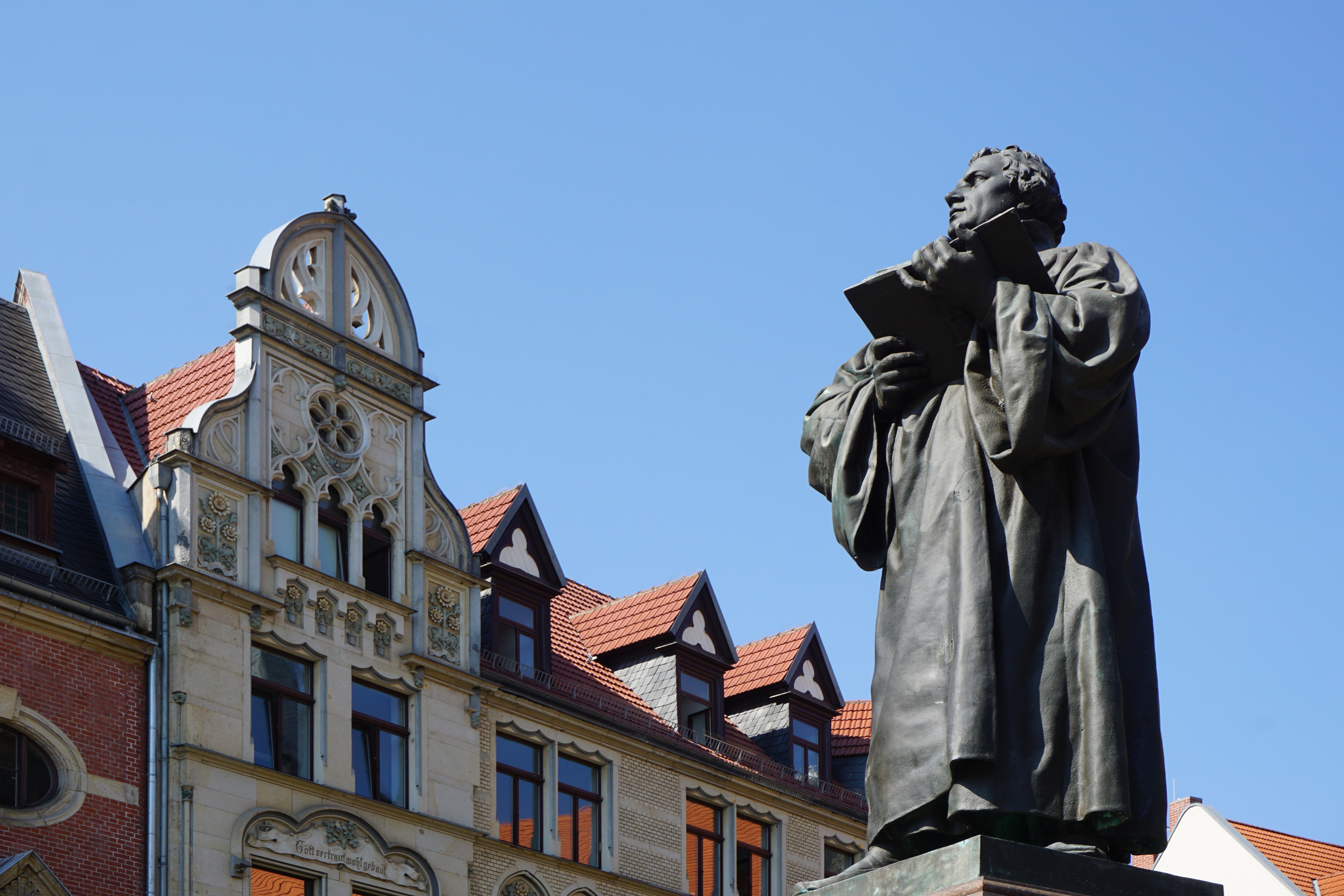
Martin Luther
The career of a reformer
The quiet child
When the Luder family in Eisleben has a new arrival on 10 November 1483, nobody suspects that this child will one day change the world. The parents come from wealthy farming families. The father acquires a fortune as the leaseholder of a copper mine and rises to the position of councillor in Mansfeld. Little Martin has a good start and receives a comprehensive education in various schools from Mansfeld and Eisleben to Magdeburg and Eisenach. Chronicles describe him as a quiet, obedient child who studies hard and shows talent.
Birth house of Martin Luther in Lutherstadt Eisleben ©Matthias Sasse, IMG Sachsen-Anhalt mbH
The eager student
At the age of seventeen, following the wish of his father, Martin enrols at Erfurt University to study law. Life in the turbulent trading city almost overwhelms the quiet young man. Although strict rules apply in the student dormitories, breaking the rules is the order of the day. This includes binge drinking in pubs, fights in the streets and visits to the prostitutes near Cathedral Hill. Martin tends to keep a low profile and is a high-flying student. He completes his basic studies of the ‘Seven Liberal Arts’ in record time. He reads the Bible and is impressed by the power of its words. In 1505, he finishes the basis studies with a Magister Artium degree. The path to studying law is now open.
The truth-seeking monk
Is a thunderstorm really to blame for Martin Luther's decision to become a monk? At least that is the explanation the young man offers his father. He says he has promised St Anne to dedicate his life to God in exchange for her help during the storm. Father Luder is furious that his son is opposing his plans. But Martin remains steadfast and joins the Augustinian order. Life as a monk is harder than expected. He perseveres and is ordained a priest in Erfurt Cathedral in 1507. The writings of the humanists influence him. True to their slogan ‘Ad Fontes!’ (To the sources), he studies the original Greek and Hebrew texts of the Bible. Always searching the eternal truth.


The irritated theologian
Since 1512, Martin Luther has been a Doctor of Theology. He is a teacher at the University of Wittenberg. Time and again, he scrutinises his convictions based on biblical texts. He recognises unalterable truths in them. At the same time, he is irritated by common practices of the church, such as the sale of indulgences. How should Christians behave? Become worthy of God's grace through their own actions? Or undo bad deeds with money? His answer is clear. He sees a need for action and drafts 95 theses, which, according to legend, he nails to the Wittenberg Castle Church door on 31 October 1517. What was supposed to be the basis of a disputation triggers a storm and paves the way for the Reformation.
The stubborn reformer
Printing helps spread Luther's theses quickly. The world is soon divided into supporters and opponents. Rome rages and demands Martin to recant, otherwise he will be banned. But he will not be deterred. ‘Here I stand. I can do no other,’ he is reported to have said. Beforehand, he had already burned the papal bull threatening him with excommunication. His life is in danger and his sovereign hides him from his persecutors at Wartburg Castle. There he takes on a great work: The translation of the New Testament. He is not aware that his text will one day become the basis of a standardised German language. In 1522, he is back in Wittenberg. The tide has turned - Protestant forces are gaining influence.
Luther Bible of Wartburgstiftung in Eisenach ©Florian Trykowski, Thüringer Tourismus GmbH
The opportune subject
In Wittenberg, Martin takes over the leadership of the new movement. But he is not a radical. He makes this clear in his criticism of the ‘iconoclasts’ and emphasises that secular authorities must be obeyed. For him, the ‘freedom of a Christian’ lies within, in man’s own relationship with God. He preaches against violence and condemns the rebellious peasants. Martin Luther is not a revolutionary. He is committed to truth in faith but fits into the existing social system.
The surprised husband
A group of nuns who have escaped from the Marienthron convent in Saxony prompt Luther to act as a matchmaker. He has criticised convent life; the nuns have followed his words and now he feels a responsibility towards them. He does not want to marry himself at first. Then he feels obliged to do so and marries Katharina von Bora, if only out of a sense of duty. And life surprises him. Love comes and with it six children. He calls his wife Käthe ‘my morning star in Wittenberg, my mistress and commander’. Sometimes also ‘Mr Käthe’, in admiration of her practical and prudent way of running the parish household.
Wittenberg Castle Church ©Francesco Carovillano, Deutsche Zentrale für Tourismus e.V.
The old fighter
The ageing Luther travels a lot, to Schmalkalden, Weimar and Gotha. Time and again he is ill and suffers pain. Sometimes he thinks he is going to die. He becomes harsher in his judgement, expresses irreconcilable opinions about the Jews and argues with the Swiss reformer Zwingli about principles. He condemns the papacy in writings as ‘created by the devil’. He grieves over the death of a daughter. In 1546, he travels to Eisleben again to settle a dispute. He succeeds, but it is his last act. The reformer dies at the age of 62 in the town where he was born. His last journey takes him to the Castle Church in Wittenberg, where he is laid to rest.
Header: ©Erfurt Tourismus & Marketing GmbH


